



HPE Tech Jam 2026 – Excitement & Reflections
Jonas Hammarbäck was recently in Vienna at HPE Tech Jam 2026, a few intense days focusing on Central, Central NAC, Mist, AI and the future of networking.
Here are his main impressions and lessons learned, structured by day.

Monday – Central, Mist and AI in practice
A clear common thread during the first day was how Aruba Central and Juniper Mist will approach each other. Both platforms are based on micro services and the development is moving towards a common architecture. Going forward, the functionality will be more similar but there will continue to be two separate GUI platforms. This is so that customers who have already chosen one supplier will feel that they can safely continue to use the environment.
Central On-Prem – for real
Central On-Prem was a major topic of discussion:
- Support for on-prem and private cloud
- A scaled-down Central On-Prem variant that requires only one appliance versus the current three.
- A major mobile player is already rolling out Central On-Prem in production. So it’s probably not that long before it’s released publicly
One feature that was mentioned in connection with Central On-prem but which relates to regular Central is that a solution is being worked on to handle roaming and distribution of keys if the connection to Central is lost. In practice, this means that the KMS function has a local copy that can take over if Central cannot be reached.
AI features for everyday life
Some of the AI features mentioned are:
- Agentic AI for faster troubleshooting by allowing AI agents to not only analyze traffic patterns but also diagnose and resolve faults. Here, the vision is that many faults can be resolved automatically
- ORCA – orchestrated root cause analysis that automatically performs the same tests that a technician would otherwise do manually, thereby significantly reducing troubleshooting time, and also contributing to the possibilities of automated remediation
- A Large Experience Model that learns what good and bad Teams and Zoom calls look like, making troubleshooting experience issues much easier
And a simple but important tip:
👉 use thumbs down and feedback in Central when something doesn’t work. It gets read – and influences priorities
Tuesday – Zero Trust, NAC and Edge thinking
Starting the day with a general keynote, I then chose to focus on Zero Trust and NAC, with Mist at the center. Mist’s NAC service Access Assurance works in practice as Central NAC will work. Some interesting points from the talk are:
- Third-party equipment not managed in Mist can use the service via RADIUS proxy
- Mist Edge, which can be compared to an Aruba gateway, is the device that acts as a RADIUS proxy
- The GUI for Access Assurance looked very simple and nice during a demo.
Very clear views for policies, enforcement and authentication flows.
The logs stood out positively:
Authentication issues, DHCP logs etc. are displayed in a simple and educational interface. Easy to understand even when something goes wrong.
Access Assurance and outages to the cloud
If you use Access Assurance for authentication, Mist Edge can act as a cached authentication service if the cloud is not available. Access Assurance also includes features such as:
- Mist Native PKI for Windows, MacOS, iOS, Android and Linux
- Integrated SCEP with Intune, Jamf and Google Workspace
Wednesday – Mist Deep dive and Central NAC
The Mist deep dive session explained how Mist works and there was also some repetition of information from Monday with how Mist and Central will be cross-fertilized. Cross-fertilized can probably be classified as the buzz word of the event.
It was talked about the scalability of the Mist platform and the largest customer today has about 380000 access points, 90000 switches and 2 million simultaneous users in principle daily. Every day about 10 million unique devices and 200 million unique devices every month that connect to the network. However, it was not mentioned which customer it is.
Central NAC
Central NAC is available in the new Central and comes in two versions. The simpler form, previously called Cloud Auth, is included in all licenses. The more advanced one will be licensed in much the same way as ClearPass Access licenses today, but with a subscription model as it is the only one available in Central.
Exactly what the licensed version will be called still seems a little unclear. But it is usually referred to as Advanced. But it remains to be seen if that is the final name.
Thursday- Keynote and more deep dives
The keynote for Networking was largely about “AI for Networking” and “Networking for AI”. That is, how AI is used to manage and optimize the network, and the new requirements placed on the network to support the huge amounts of data that AI handles.
But personally, I am a little skeptical about whether the development is really going in the right direction. On the one hand, they say that a certain AP saves 4 W compared to another AP and that you can turn off APs that are not used. On the other hand, they talk about data centers that have a total power of 2 GW today and that data centers up to 10 GW are planned. To put that power into perspective, Sweden’s nuclear power plants have a combined power of 6-7 GW…
Central mm
Several technical news worth mentioning that was talked about on a deep dive about Central is that today’s Central, which is what used to be called New Central (CNX) is in a hybrid version right now. This is because some functions such as configuration of many different device types still need to be done in Classic Central. When all parts can be configured in Central, you will leave hybrid mode.
An important difference between Native mode and hybrid mode in Central is that in hybrid you cannot fully utilize the hierarchy but are forced to work with Device Groups. This is because the concepts of Global, Site Collection and Site do not exist in Classic Central.
So when Native is activated, you will be able to set configuration at different levels that are then inherited downwards. With version 10.8, support is added for APs to retrieve keys via gateway for faster roaming instead of going all the way to Central in the cloud. This is mainly relevant if you have high latency to Central.
Broadcast, multicast and roaming
An unexpectedly deep, but very useful, session was on broadcast and multicast.
- Hiding an SSID has always been bad. With 6 GHz it gets even worse. Because with hidden, the advertisements that are on 5 GHz are hidden, which means that the clients do not see the 6 GHz SSID at all. Which gives bad roaming.
- Gateway has to replicate broadcast and multicast to each tunnel which is very CPU intensive
- Broadcast is sent by default with the lowest data rate, so if you have not adjusted the values, it will be 1 Mbit/s on the 2.4 GHz band.
- DMO (Dynamic Multicast Optimization) converts to unicast and increases the data rate, but there are also some problems with enabling this feature. For example, it makes broadcast and multicast filtering no longer work and everything is sent out.
- Multicast Transmission Optimization, is a feature that may sound good to turn on. But it has a very unclear function and should only be used in some very specific situations when sending video via multicast
Final reflection
The Tech Jam in Vienna gave a clear picture of the direction:
- Central and Mist will have similar features but keep their respective platforms and GUI
- AI is increasingly used for concrete operational problems, not just dashboards
- Central On-Prem is not a sidetrack but will hopefully become a product to use
Overall, it feels like Juniper/HPE is taking big steps towards simplifying operations in complex environments, without compromising on control or security. It will be very interesting to follow how quickly these parts actually land in live environments.
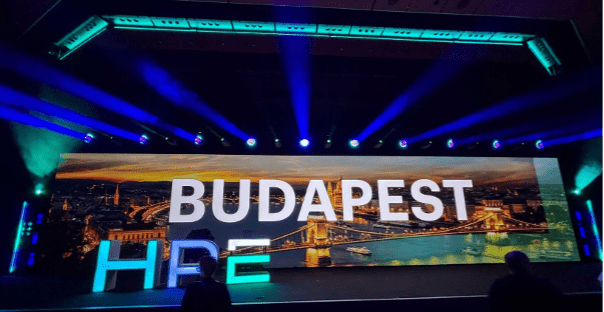
Finally, it was announced that the Tech Jam will be held in Budapest in May for the next three years.